The way Japanese people deal with illness is different than anything else I’ve seen. I actually like it. Sometimes.
Basically, in Japan, if you are sick, you go to the doctor. It doesn’t matter what you are sick with. If it is a cold, you go to the doctor. If it is the flu, you go to the doctor. If you happen to have burned yourself by spilling hot chocolate all over your stomach in a fit of stupidity, you go to the doctor. (I didn’t actually go to the doctor for this, but they wanted me to).
The funny thing is, though, that even though EVERYONE goes to the doctor for EVERYTHING, they still seem to have enough space for everyone! It takes absolutely no time to get an appointment, even for a specialist.
While I’ve been in Japan, I’ve seen an eye doctor, two general practitioners, a psychologist, a psychiatrist, and a dentist. And it took pretty much no time to get these appointments. I just showed up and in we went. This is really great.
However, when you ARE sick, the medicine you are prescribed doesn’t seem to do much of anything. It is very week, but they prescribe so much of it! I don’t know what to make of this.
Finally, if you have a problem, you don’t go to see a GP then get a referral to a specialist. You just go see the specialist immediately. I woke up one day with pinkeye, and we went to an eye doctor. That wouldn’t happen back at home.
Healthcare in Japan is interesting. I kind of like it.
Thursday, July 19, 2012

Tuesday, June 19, 2012
8. The Adoption of Western Symbolism
There is absolutely nothing funnier to me than Engrish. Even if it is spelled perfectly and is completely grammatical, English in Japan is just so... Japanese.
Here are some great examples, taken from my own experiences:


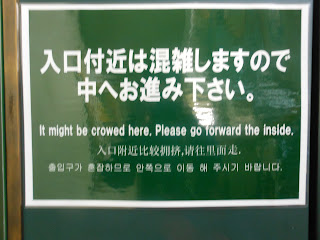
I find it fascinating that this English is written on pencil cases and shirts; billboards and street signs, packaging and postage stamps; and yet nobody seems to know what any of it means. Nobody even has to make sure it makes sense, because the only people it causes any problem (read: amusement) for are the practically negligible number of foreigners.
You would think that if you have this much English, albeit ridiculous English, in your culture, that you would make an effort to learn the language, but this is only true for students that aren’t at my schools. Apparently.
Anyway, Engrish is funny. That was my main point.
Here are some great examples, taken from my own experiences:


I find it fascinating that this English is written on pencil cases and shirts; billboards and street signs, packaging and postage stamps; and yet nobody seems to know what any of it means. Nobody even has to make sure it makes sense, because the only people it causes any problem (read: amusement) for are the practically negligible number of foreigners.
You would think that if you have this much English, albeit ridiculous English, in your culture, that you would make an effort to learn the language, but this is only true for students that aren’t at my schools. Apparently.
Anyway, Engrish is funny. That was my main point.
 |
| This isn't Engrish, but it's hilarious. |
7: Helpless Women
Dear Japanese Women,
You are smart, funny and sexy. You have brilliant ideas and you can do anything you set your mind to. If you want to learn English, you can learn English. If you want to play sports, play sports. If you want to be a doctor, nurse, hairdresser, anything, you can do it.
So seriously, stop acting like you can’t do anything. It isn’t cute.
I know that you think boys will like you more if you pretend that you can’t do things, but your attitude is getting in the way of you actually achieving anything. If I see one more student giggle in class and say “I don’t know, I don’t understand!” while smiling and nudging her friends, I might just smack some sense into them.
If I see you swinging a bad badly on purpose on the field, I will laugh at you.
That being said, I realize that not all Japanese women are like this. Many of them are strong, independent and really great. It just seems that the culture perpetuates this idea that women are less than men and are expected to act as such if they want to be seen as proper women. And that’s not cool.
So chill out. You're awesome.
Love,
Jeri
 |
| I don't have photos of Japanese girls, so here's one of me and my mom in Japan! |
Tuesday, June 12, 2012
#6: Japanese Fashion
I’m sure many people, both Japanese and foreign, absolutely love Japanese fashion. They feel like it fits perfectly into their little vision of the world. Unfortunately, I am neither of those people. Japanese fashion never fails to confuse and perplex me, both out in the real world and while I’m at work.
Let’s start with work. I work at a Senior High School, where the dress code is professional. No t-shirts, no jeans. You all know what professional is. Imagine my surprise when I showed up on my first day in a pencil skirt, a white button-down blouse, and a pair of heels, and only about half the office was wearing anything remotely businessy. What was the other half wearing, you may ask? I’m glad you did.
They were wearing track suits. Track suits with perfectly matching tops and bottoms, manufactured by adidas, nike, or any other sports brand you could think of. In fact, I’m pretty sure that Japanese schoolteachers are single-handedly keeping these companies in business. Forget running shoes and fancy pacemakers, track suits are their market. I didn’t let this get to me, though. I just assumed that all these teachers wearing track suits must have been PE teachers. Imagine my surprise, 8 months later, when I am invited to my first enkai and I finally get around to asking what subjects the teachers teach.

“My neighbour teaches PE, right?” I asked my supervisor, looking over at his track-suit.
“Right.” she replied, following my gaze.
“And my other neighbour?” My glance skipping over to another tracksuit-clad teacher.
“He teaches history.” she replied.
“Not PE?” I asked, surprised.
“Nope.”
“What about her? And him? And him?” I asked, picking out teachers at random.
“Japanese. Science. Also History.”
“None of them teach PE?” I asked, completely floored at this point.
“Nope, how many PE teachers did you think we had?!” my supervisor asked.
“Quite a few,” I admitted sheepishly, looking at the ground as my face turned red.
My point is that track suits are standard business attire at a high school, and for some reason I’m not allowed to wear jeans. I would personally never wear a track suit, but I can understand why others would if they are socially acceptable. I’m sure the things are comfy!
Then there is the question of what I am allowed to wear. When I was back in Canada, I knew what was business appropriate and what wasn’t, and I dressed accordingly. Here, that has mostly been completely thrown out the window. For example, My pencil skirts that I thought were great are too revealing. They have slits in the back. So I can walk. Also, any time I wear a shirt that shows a hint of collarbone, I suddenly have 50 teachers asking me if I’m cold. I get it guys, I’ll cover up a bit more. These things are okay, though. I understand them, even if it means I have to buy more appropriate shirts.
Once I get out of work, I figure I have a decent idea of how I’m supposed to dress myself in my spare time. I am a 21 year old girl, so I like to look youthful and stylish, but I try not to forget that I am still a teacher and have to be professional. I walk out my house feeling pleased with myself, wearing a floral tank top, jeans rolled up to my knees, and ballet flats. Then I realize that no one else shows their shoulders. Ever. I realize I don’t have a cardigan with me, so I throw my scarf around my shoulders, hoping that people think it’s some sort of new fashion. I don’t think I have to worry though.
A group of girls walks past me in skirts so short that I’m pretty sure I could see their underwear if I tried. These are my students. I’m learning the rules. Legs are fine, but I can’t show my shoulders. Got it. I’ve learned the rules.
Let’s start with work. I work at a Senior High School, where the dress code is professional. No t-shirts, no jeans. You all know what professional is. Imagine my surprise when I showed up on my first day in a pencil skirt, a white button-down blouse, and a pair of heels, and only about half the office was wearing anything remotely businessy. What was the other half wearing, you may ask? I’m glad you did.
 |
| I have no photos of me looking businessy, but here's one sort of! |
They were wearing track suits. Track suits with perfectly matching tops and bottoms, manufactured by adidas, nike, or any other sports brand you could think of. In fact, I’m pretty sure that Japanese schoolteachers are single-handedly keeping these companies in business. Forget running shoes and fancy pacemakers, track suits are their market. I didn’t let this get to me, though. I just assumed that all these teachers wearing track suits must have been PE teachers. Imagine my surprise, 8 months later, when I am invited to my first enkai and I finally get around to asking what subjects the teachers teach.

“My neighbour teaches PE, right?” I asked my supervisor, looking over at his track-suit.
“Right.” she replied, following my gaze.
“And my other neighbour?” My glance skipping over to another tracksuit-clad teacher.
“He teaches history.” she replied.
“Not PE?” I asked, surprised.
“Nope.”
“What about her? And him? And him?” I asked, picking out teachers at random.
“Japanese. Science. Also History.”
“None of them teach PE?” I asked, completely floored at this point.
“Nope, how many PE teachers did you think we had?!” my supervisor asked.
“Quite a few,” I admitted sheepishly, looking at the ground as my face turned red.
My point is that track suits are standard business attire at a high school, and for some reason I’m not allowed to wear jeans. I would personally never wear a track suit, but I can understand why others would if they are socially acceptable. I’m sure the things are comfy!
Then there is the question of what I am allowed to wear. When I was back in Canada, I knew what was business appropriate and what wasn’t, and I dressed accordingly. Here, that has mostly been completely thrown out the window. For example, My pencil skirts that I thought were great are too revealing. They have slits in the back. So I can walk. Also, any time I wear a shirt that shows a hint of collarbone, I suddenly have 50 teachers asking me if I’m cold. I get it guys, I’ll cover up a bit more. These things are okay, though. I understand them, even if it means I have to buy more appropriate shirts.
 |
| Appropriate work attire? |
Once I get out of work, I figure I have a decent idea of how I’m supposed to dress myself in my spare time. I am a 21 year old girl, so I like to look youthful and stylish, but I try not to forget that I am still a teacher and have to be professional. I walk out my house feeling pleased with myself, wearing a floral tank top, jeans rolled up to my knees, and ballet flats. Then I realize that no one else shows their shoulders. Ever. I realize I don’t have a cardigan with me, so I throw my scarf around my shoulders, hoping that people think it’s some sort of new fashion. I don’t think I have to worry though.
 |
| TOO MUCH SHOULDER! |
A group of girls walks past me in skirts so short that I’m pretty sure I could see their underwear if I tried. These are my students. I’m learning the rules. Legs are fine, but I can’t show my shoulders. Got it. I’ve learned the rules.
 |
| Me doing Japanese fashion right (sort of)! |
Also, since they wear so many layers up top, they can have really frilly undergarments. I haven’t seen a single bra in a store that wouldn’t show under a t-shirt. Frankly, Japanese underwear scares me.

But there’s more! I had gotten the hang of dressing myself in Hokkaido, then I went to Tokyo and saw the Lolita fashion. These girls dress up in these victorian-era dresses, altered so that they are shorter, and accessorize with stockings, mary janes and headdresses.. The name comes from the female name Lolita, which according to Wikipedia referred to Japan’s links to Portugal, where the girls are pretty and modest. The trend started in the 1970’s and grew from there. I can’t say I really get it.
Finally, Japanese women seem to dress for style rather than comfort. I know this happens in most places, but they take it to the extreme. Japanese women wear 4 inch heels hiking. Hiking! There is wanting to look cute and then there is being crazy!
I’m sorry that that pieces was kind of all over the place, but I hope you got from it the main point: Japanese fashion confuses me.

But there’s more! I had gotten the hang of dressing myself in Hokkaido, then I went to Tokyo and saw the Lolita fashion. These girls dress up in these victorian-era dresses, altered so that they are shorter, and accessorize with stockings, mary janes and headdresses.. The name comes from the female name Lolita, which according to Wikipedia referred to Japan’s links to Portugal, where the girls are pretty and modest. The trend started in the 1970’s and grew from there. I can’t say I really get it.
 |
| Lolita fashion |
Finally, Japanese women seem to dress for style rather than comfort. I know this happens in most places, but they take it to the extreme. Japanese women wear 4 inch heels hiking. Hiking! There is wanting to look cute and then there is being crazy!
I’m sorry that that pieces was kind of all over the place, but I hope you got from it the main point: Japanese fashion confuses me.
#5: Table Manners and Etiquette
This one isn’t perplexing so much. I understand where a lot of the rules and etiquette come from. It doesn’t make it any harder to follow though.

You cannot pass food from chopsticks to chopsticks, because that’s what they do with bones at a funeral. You cannot stick your chopsticks in your rice because they stick the chopsticks in the ashes at a funeral? Is that right?

Also, you must start and end each meal with a saying. The saying at the beginning is “itadakimasu” or “I gratefully receive”, loosely translated. The saying at the end is “gochisosama deshita”, or “it was a feast”, designed to convey respect and gratitude for the food you’ve just eaten.

When drinking alcohol, you’re not supposed to refill your own glass. Wait for someone else to do it for you, and always offer to fill someone else’s if you see that they’re getting low.

Finally, slurping your noodles is alright. In fact, you should do it. Apparently it is so that you can eat the hot ramen without burning yourself, thereby keeping the maximum taste.

This is just my experience, and could be completely wrong. If I’ve made any glaring errors, please correct me in the comments. I quite like the table manners, although I do at least one thing wrong at every single meal.

You cannot pass food from chopsticks to chopsticks, because that’s what they do with bones at a funeral. You cannot stick your chopsticks in your rice because they stick the chopsticks in the ashes at a funeral? Is that right?
Also, you must start and end each meal with a saying. The saying at the beginning is “itadakimasu” or “I gratefully receive”, loosely translated. The saying at the end is “gochisosama deshita”, or “it was a feast”, designed to convey respect and gratitude for the food you’ve just eaten.

When drinking alcohol, you’re not supposed to refill your own glass. Wait for someone else to do it for you, and always offer to fill someone else’s if you see that they’re getting low.

Finally, slurping your noodles is alright. In fact, you should do it. Apparently it is so that you can eat the hot ramen without burning yourself, thereby keeping the maximum taste.

This is just my experience, and could be completely wrong. If I’ve made any glaring errors, please correct me in the comments. I quite like the table manners, although I do at least one thing wrong at every single meal.
Thursday, May 17, 2012
Perplexing Thing About Japan #4: The Pornography/Sex Culture
Okay, to be fair, I don’t know THAT much about the pornography laws. From what I can tell based on a quick look at wikipedia about 5 seconds ago, it seems that in Japan, under Article 175 of the Criminal Code of Japan, people who sell or distribute obscene materials can be punished by fines or imprisonment. This particular code has remained the same since it came into being back in 1907. However, what has changed is what Japanese society deems as “obscene materials”.
Despite this clause in the Criminal Code, there is quite a thriving porn industry in Japan. In order to get around the clause, they simply obscure the genitals (or part of it? I don’t know, I’ve never actually watched Japanese porn).
Besides all this, there also seems to be quite a market for things beyond the norm, I don’t want to get too much into it, since this blog is a place for peace and love and normalcy, etc, but anime porn is quite big in Japan, and I’m pretty sure you can buy magazines upon magazines at any convenience store. I don’t really understand it. Also, pretty much any other fetish you can imagine exists here, from what I’ve been told.

There also seems to be a very disturbing subculture built around the sexualization of youth. Before child pornography itself was banned in Japan in 1999, apparently ⅔ of child porn was Japanese. Now, instead, adults are dressed as children, with school-girls being particularly popular. This is not just subculture, but it quite popular, perpetuated by girl groups like AKB48. It’s really worrisome, and I try not to think about it too much.

Now, like I said, all I know is what I learned from wikipedia and what I see around me in real life, but it’s definitely an interesting thing. If you’re interested in reading more about it, I would recommend that you read the wiki. Or watch the porn, I don’t judge you.
Despite this clause in the Criminal Code, there is quite a thriving porn industry in Japan. In order to get around the clause, they simply obscure the genitals (or part of it? I don’t know, I’ve never actually watched Japanese porn).
Besides all this, there also seems to be quite a market for things beyond the norm, I don’t want to get too much into it, since this blog is a place for peace and love and normalcy, etc, but anime porn is quite big in Japan, and I’m pretty sure you can buy magazines upon magazines at any convenience store. I don’t really understand it. Also, pretty much any other fetish you can imagine exists here, from what I’ve been told.
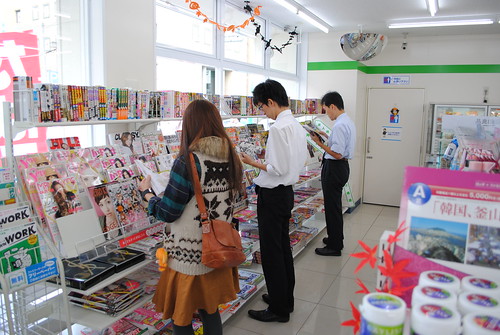
There also seems to be a very disturbing subculture built around the sexualization of youth. Before child pornography itself was banned in Japan in 1999, apparently ⅔ of child porn was Japanese. Now, instead, adults are dressed as children, with school-girls being particularly popular. This is not just subculture, but it quite popular, perpetuated by girl groups like AKB48. It’s really worrisome, and I try not to think about it too much.

Now, like I said, all I know is what I learned from wikipedia and what I see around me in real life, but it’s definitely an interesting thing. If you’re interested in reading more about it, I would recommend that you read the wiki. Or watch the porn, I don’t judge you.
Monday, May 14, 2012
Perplexing Things About Japan 3: Face Masks
This one is going to be quite short. Basically, you know those surgical face covering masks? Japanese people seem to love those things. I’m not entirely sure why, but at least 2 or 3 of my students are always wearing them.
Why, you ask?

Because the students are sick, and wearing a mask prevents the spread of infection. In fact, I should probably be wearing a mask at work as I type this because I’m pretty sure I’ve got a little bit of a cough.

Except here’s the thing. I’ve seen people wearing masks by themselves inside their own cars, which is doing absolutely nothing to spread germs to the people around them because there are no people around them. Also, they actually will take off the masks to cough or sneeze, which undoes all the germ trapping that the mask is supposed to be doing.

If you are sick enough to wear a mask, you are sick enough to stay home.
Why, you ask?
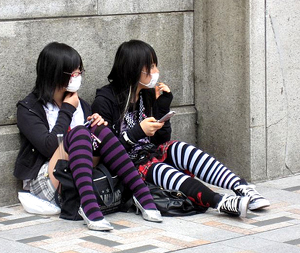
Because the students are sick, and wearing a mask prevents the spread of infection. In fact, I should probably be wearing a mask at work as I type this because I’m pretty sure I’ve got a little bit of a cough.

Except here’s the thing. I’ve seen people wearing masks by themselves inside their own cars, which is doing absolutely nothing to spread germs to the people around them because there are no people around them. Also, they actually will take off the masks to cough or sneeze, which undoes all the germ trapping that the mask is supposed to be doing.

If you are sick enough to wear a mask, you are sick enough to stay home.
Subscribe to:
Posts (Atom)